Colorblindness Explained !
Colorblindness Explained !
Colorblindness Explained !
Colorblindness Explained !
Colorblindness Explained !
What is Colorblindness?
What is Colorblindness?
What is Colorblindness?
What is Colorblindness?
What is Colorblindness?
Colorblindness, more accurately called Color Vision Deficiency (CVD), is a vision condition where a person has difficulty distinguishing certain colors. It occurs when one or more types of cone cells in the retina, which detect color, are absent or not functioning properly.
Red-green, blue-yellow, and complete colorblindness are the main forms, each affecting color perception in different ways. People with CVD often see colors as less vivid or confuse similar shades, which can affect daily activities like choosing clothing, reading charts, or interpreting signals. The condition is usually inherited, though it can also result from eye injuries, diseases, or aging.
Colorblindness, more accurately called Color Vision Deficiency (CVD), is a vision condition where a person has difficulty distinguishing certain colors. It occurs when one or more types of cone cells in the retina, which detect color, are absent or not functioning properly.
Red-green, blue-yellow, and complete colorblindness are the main forms, each affecting color perception in different ways. People with CVD often see colors as less vivid or confuse similar shades, which can affect daily activities like choosing clothing, reading charts, or interpreting signals. The condition is usually inherited, though it can also result from eye injuries, diseases, or aging.
Colorblindness, more accurately called Color Vision Deficiency (CVD), is a vision condition where a person has difficulty distinguishing certain colors. It occurs when one or more types of cone cells in the retina, which detect color, are absent or not functioning properly.
Red-green, blue-yellow, and complete colorblindness are the main forms, each affecting color perception in different ways. People with CVD often see colors as less vivid or confuse similar shades, which can affect daily activities like choosing clothing, reading charts, or interpreting signals. The condition is usually inherited, though it can also result from eye injuries, diseases, or aging.
Colorblindness, more accurately called Color Vision Deficiency (CVD), is a vision condition where a person has difficulty distinguishing certain colors. It occurs when one or more types of cone cells in the retina, which detect color, are absent or not functioning properly.
Red-green, blue-yellow, and complete colorblindness are the main forms, each affecting color perception in different ways. People with CVD often see colors as less vivid or confuse similar shades, which can affect daily activities like choosing clothing, reading charts, or interpreting signals. The condition is usually inherited, though it can also result from eye injuries, diseases, or aging.
How does CVD work?
How does CVD work?
How does CVD work?
How does CVD work?
How does CVD work?
What goes wrong in colorblindness ?
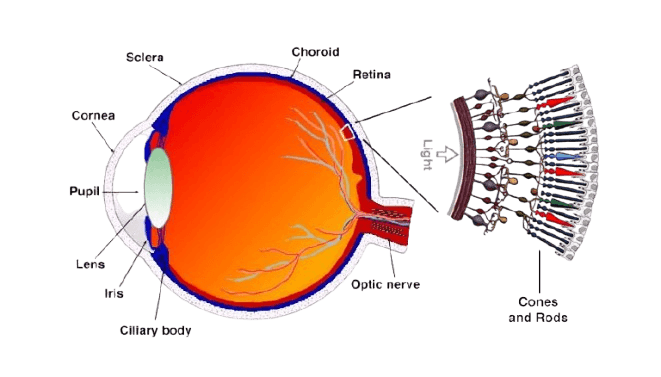
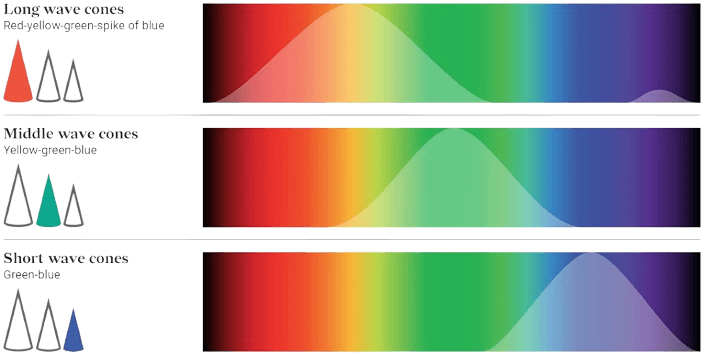
CVD occurs when one or more types of cones do not function properly or are absent.
Depending on which cone is affected:
Red or green cone problems —> red-green CVD
Blue cone problems —> blue-yellow CVD
All cones missing or nonfunctional —> complete colorblindness
What goes wrong in colorblindness ?
CVD occurs when one or more types of cones do not function properly or are absent.
Depending on which cone is affected:
Red or green cone problems
—> red-green CVD
Blue cone problems
—> blue-yellow CVD
All cones missing or nonfunctional
—> complete colorblindness (CCVD)
What goes wrong in colorblindness ?
CVD occurs when one or more types of cones do not function properly or are absent.
Depending on which cone is affected:
Red or green cone problems —> red-green CVD
Blue cone problems —> blue-yellow CVD
All cones missing or nonfunctional —> complete colorblindness
What goes wrong in colorblindness ?
CVD occurs when one or more types of cones do not function properly or are absent.
Depending on which cone is affected:
Red or green cone problems —> red-green CVD
Blue cone problems —> blue-yellow CVD
All cones missing or nonfunctional —> complete colorblindness
How it does it affect the perception of color?
When a cone type is missing or abnormal, the brain cannot correctly process that part of the color spectrum.
For example:
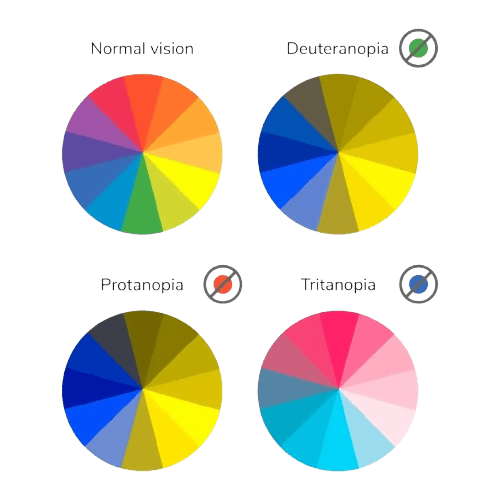
A person with deuteranopia (green cones absent) may see green and red as very similar or muted.
A person with tritanopia (blue cones absent) may see blue as green and yellow as pinkish.
Summary:
CVD is essentially a problem in the cone cells of the retina, which prevents the brain from correctly distinguishing certain colors. Therefore, individuals affected by CVD often see colors as less vivid or confuse certain shades. The type of colorblindness depends on which cones are affected, and severity depends on whether the cone is partially functional (anomaly) or completely absent (anopia).
How it does it affect the perception of color?
When a cone type is missing or abnormal, the brain cannot correctly process that part of the color spectrum.
For example:
A person with deuteranopia (green cones absent) may see green and red as very similar or muted.
A person with tritanopia (blue cones absent) may see blue as green and yellow as pinkish.
Summary:
CVD is essentially a problem in the cone cells of the retina, which prevents the brain from correctly distinguishing certain colors. Therefore, individuals affected by CVD often see colors as less vivid or confuse certain shades. The type of colorblindness depends on which cones are affected, and severity depends on whether the cone is partially functional (anomaly) or completely absent (anopia).
How it does it affect the perception of color?
When a cone type is missing or abnormal, the brain cannot correctly process that part of the color spectrum.
For example:
A person with deuteranopia (green cones absent) may see green and red as very similar or muted.
A person with tritanopia (blue cones absent) may see blue as green and yellow as pinkish.
Summary:
CVD is essentially a problem in the cone cells of the retina, which prevents the brain from correctly distinguishing certain colors. Therefore, individuals affected by CVD often see colors as less vivid or confuse certain shades. The type of colorblindness depends on which cones are affected, and severity depends on whether the cone is partially functional (anomaly) or completely absent (anopia).
How it does it affect the perception of color?
When a cone type is missing or abnormal, the brain cannot correctly process that part of the color spectrum.
For example:
A person with deuteranopia (green cones absent) may see green and red as very similar or muted.
A person with tritanopia (blue cones absent) may see blue as green and yellow as pinkish.
Summary:
CVD is essentially a problem in the cone cells of the retina, which prevents the brain from correctly distinguishing certain colors. Therefore, individuals affected by CVD often see colors as less vivid or confuse certain shades. The type of colorblindness depends on which cones are affected, and severity depends on whether the cone is partially functional (anomaly) or completely absent (anopia).
Problem:
CVD can only possibly be treated if it's caused by medication, injury, or an eye disease depending on the underlying cause.
Since genetic color vision deficiency is not curable, we made our own unique solution to help aid the individuals affected by it.
Our solution:
A specialized tool, Bicoloro, can help people with color vision deficiency see colors more clearly, making tasks like reading charts, picking clothing, or interpreting signals easier which makes them more independent. No guessing colors anymore!
Problem:
CVD can only possibly be treated if it's caused by medication, injury, or an eye disease depending on the underlying cause.
Since genetic color vision deficiency is not curable, we made our own unique solution to help aid the individuals affected by it.
Our solution:
A specialized tool, Bicoloro, can help people with color vision deficiency see colors more clearly, making tasks like reading charts, picking clothing, or interpreting signals easier which makes them more independent. No guessing colors anymore!
Problem:
CVD can only possibly be treated if it's caused by medication, injury, or an eye disease depending on the underlying cause.
Since genetic color vision deficiency is not curable, we made our own unique solution to help aid the individuals affected by it.
Our solution:
A specialized tool, Bicoloro, can help people with color vision deficiency see colors more clearly, making tasks like reading charts, picking clothing, or interpreting signals easier which makes them more independent. No guessing colors anymore!
Problem:
CVD can only possibly be treated if it's caused by medication, injury, or an eye disease depending on the underlying cause.
Since genetic color vision deficiency is not curable, we made our own unique solution to help aid the individuals affected by it.
Our solution:
A specialized tool, Bicoloro, can help people with color vision deficiency see colors more clearly, making tasks like reading charts, picking clothing, or interpreting signals easier which makes them more independent. No guessing colors anymore!
All types of CVD
All types of CVD
All types of CVD
All types of CVD
All types of CVD
Color Vision Deficiency (CVD) is divided into three main types: red-green, blue-yellow, and complete colorblindness. Each has its specific subtypes. Knowing the types is important because they affect color perception differently, and understanding them can help in daily tasks, education, and designing accessible visuals for people with CVD.
Color Vision Deficiency (CVD) is divided into three main types: red-green, blue-yellow, and complete colorblindness. Each has its specific subtypes. Knowing the types is important because they affect color perception differently, and understanding them can help in daily tasks, education, and designing accessible visuals for people with CVD.
Color Vision Deficiency (CVD) is divided into three main types: red-green, blue-yellow, and complete colorblindness. Each has its specific subtypes. Knowing the types is important because they affect color perception differently, and understanding them can help in daily tasks, education, and designing accessible visuals for people with CVD.
Color Vision Deficiency (CVD) is divided into three main types: red-green, blue-yellow, and complete colorblindness. Each has its specific subtypes. Knowing the types is important because they affect color perception differently, and understanding them can help in daily tasks, education, and designing accessible visuals for people with CVD.
Red-Green Types:
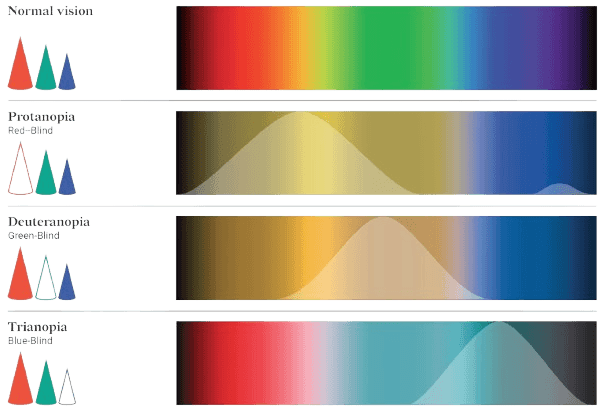
Protanomaly —> Red cones are abnormal or weak. Reds appear dimmer and may shift toward yellow or green.
Effect: Mild difficulty distinguishing red from green.
Protanopia → Red cones are absent. Reds appear dark or brown, green may look similar.
Effect: Cannot see red properly; severe red-green confusion.
Deuteranomaly → Green cones are abnormal or weak. Greens appear reddish.
Effect: Mild confusion between red and green.
Deuteranopia → Green cones are absent. Greens appear beige or brown.
Effect: Cannot distinguish green from red.
Blue-Yellow Types:
Tritanomaly → Blue cones are weak. Blues appear greener, yellows may appear paler.
Effect: Mild confusion between blue and yellow.
Tritanopia → Blue cones are absent. Blues appear green, yellows may appear pinkish.
Effect: Severe difficulty distinguishing blue and yellow.
Complete Colorblindness:
Rod Monochromacy / Achromatopsia → No functional cones; vision relies only on rods.
Effect: See everything in shades of gray; sensitive to bright light.
Cone Monochromacy → Only one type of cone works.
Effect: Can see shades of one color; all other colors appear muted or indistinct.
Red-Green Types:
Protanomaly —> Red cones are abnormal or weak. Reds appear dimmer and may shift toward yellow or green.
Effect: Mild difficulty distinguishing red from green.
Protanopia → Red cones are absent. Reds appear dark or brown, green may look similar.
Effect: Cannot see red properly; severe red-green confusion.
Deuteranomaly → Green cones are abnormal or weak. Greens appear reddish.
Effect: Mild confusion between red and green.
Deuteranopia → Green cones are absent. Greens appear beige or brown.
Effect: Cannot distinguish green from red.
Blue-Yellow Types:
Tritanomaly → Blue cones are weak. Blues appear greener, yellows may appear paler.
Effect: Mild confusion between blue and yellow.
Tritanopia → Blue cones are absent. Blues appear green, yellows may appear pinkish.
Effect: Severe difficulty distinguishing blue and yellow.
Complete Colorblindness:
Rod Monochromacy / Achromatopsia → No functional cones; vision relies only on rods.
Effect: See everything in shades of gray; sensitive to bright light.
Cone Monochromacy → Only one type of cone works.
Effect: Can see shades of one color; all other colors appear muted or indistinct.
Red-Green Types:
Protanomaly —> Red cones are abnormal or weak. Reds appear dimmer and may shift toward yellow or green.
Effect: Mild difficulty distinguishing red from green.
Protanopia → Red cones are absent. Reds appear dark or brown, green may look similar.
Effect: Cannot see red properly; severe red-green confusion.
Deuteranomaly → Green cones are abnormal or weak. Greens appear reddish.
Effect: Mild confusion between red and green.
Deuteranopia → Green cones are absent. Greens appear beige or brown.
Effect: Cannot distinguish green from red.
Blue-Yellow Types:
Tritanomaly → Blue cones are weak. Blues appear greener, yellows may appear paler.
Effect: Mild confusion between blue and yellow.
Tritanopia → Blue cones are absent. Blues appear green, yellows may appear pinkish.
Effect: Severe difficulty distinguishing blue and yellow.
Complete Colorblindness:
Rod Monochromacy / Achromatopsia → No functional cones; vision relies only on rods.
Effect: See everything in shades of gray; sensitive to bright light.
Cone Monochromacy → Only one type of cone works.
Effect: Can see shades of one color; all other colors appear muted or indistinct.
Red-Green Types:
Protanomaly —> Red cones are abnormal or weak. Reds appear dimmer and may shift toward yellow or green.
Effect: Mild difficulty distinguishing red from green.
Protanopia → Red cones are absent. Reds appear dark or brown, green may look similar.
Effect: Cannot see red properly; severe red-green confusion.
Deuteranomaly → Green cones are abnormal or weak. Greens appear reddish.
Effect: Mild confusion between red and green.
Deuteranopia → Green cones are absent. Greens appear beige or brown.
Effect: Cannot distinguish green from red.
Blue-Yellow Types:
Tritanomaly → Blue cones are weak. Blues appear greener, yellows may appear paler.
Effect: Mild confusion between blue and yellow.
Tritanopia → Blue cones are absent. Blues appear green, yellows may appear pinkish.
Effect: Severe difficulty distinguishing blue and yellow.
Complete Colorblindness:
Rod Monochromacy / Achromatopsia → No functional cones; vision relies only on rods.
Effect: See everything in shades of gray; sensitive to bright light.
Cone Monochromacy → Only one type of cone works.
Effect: Can see shades of one color; all other colors appear muted or indistinct.
How many are affected by CVD?
How many are affected by CVD?
How many are affected by CVD?
How many are affected by CVD?
How many are affected by CVD?
Color Vision Deficiency (CVD) affects an estimated 320 million people worldwide. It is much more common in men than in woman, affecting about (rough estimate) 8% of males (≈ 300-320 million people) and 0,5% of females
(≈ 20 million people) due to its strong genetic link to the X chromosome.
Scale (worldwide):
The vast majority of color vision deficiency cases are red-green types, which lie around 95% of all colorblind cases
(= ONLY congenital cases).
The red-green CVD-type is very common, affecting about ~3,5% globally (≈ 304 million people).
Protanomaly: ~0,61% (≈ 48,6 million)
Protanopia: ~0,34% (≈ 27,4 million)
Deuteranomaly: ~2,47% (≈ 197,6 million)
Deuteranopia: ~0,38% (≈ 30,4 million)
The blue-yellow CVD-type is very rare, affecting about 0,055% globally (≈ 4,4 million people).
Tritanomaly: ~0,034% (≈ 2,72 million)
Tritanopia: ~0,021% (≈ 1,68 million)
Complete colorblindness is extremely rare, affecting about 0,003% globally (≈ 240.00 people)
Rod monochomacy / achromatopsia: ~0,0015% (≈ 120.000)
Cone monochromacy: ~0,0015% (≈ 120.000)
(These are rough estimates, but give a very nice perspective)
Overall, red-green deficiencies account for the overwhelming majority of cases, while blue-yellow deficiencies and total colorblindness are very uncommon. Because the vast majority of cases are red–green, men have a much higher CVD percentage.
Color Vision Deficiency (CVD) affects an estimated 320 million people worldwide.
It is much more common in men than in woman, affecting about (rough estimate) 8% of males (≈ 300-320 million people) and 0,5% of females (≈ 20 million people) due to its strong genetic link to the X chromosome.
Scale (worldwide):
The vast majority of color vision deficiency cases are red-green types, which lie around 95% of all colorblind cases (≈ 304 million people) (= ONLY congenital cases).
The red-green CVD-type is very common, affecting about ~3,5% globally (≈ 304 million people).
Protanomaly: ~0,61% (≈ 48,6 million)
Protanopia: ~0,34% (≈ 27,4 million)
Deuteranomaly: ~2,47% (≈ 197,6 million)
Deuteranopia: ~0,38% (≈ 30,4 million)
The blue-yellow CVD-type is very rare, affecting about 0,055% globally (≈ 4,4 million people).
Tritanomaly: ~0,034% (≈ 2,72 million)
Tritanopia: ~0,021% (≈ 1,68 million)
Complete colorblindness is extremely rare, affecting about 0,003% globally (≈ 240.00 people)
Rod monochomacy / achromatopsia: ~0,0015% (≈ 120.000)
Cone monochromacy: ~0,0015%
(≈ 120.000)
(These are rough estimates, but give a very nice perspective)
Overall, red-green deficiencies account for the overwhelming majority of cases, while blue-yellow deficiencies and total colorblindness are very uncommon. Because the vast majority of cases are red–green, men have a much higher CVD percentage.
Color Vision Deficiency (CVD) affects an estimated 320 million people worldwide.
It is much more common in men than in woman, affecting about (rough estimate) 8% of males (≈ 300-320 million people) and 0,5% of females (≈ 20 million people) due to its strong genetic link to the X chromosome.
Scale (worldwide):
The vast majority of color vision deficiency cases are red-green types, which lie around 95% of all colorblind cases
(≈ 304 million people) (= ONLY congenital cases).
The red-green CVD-type is very common, affecting about ~3,5% globally (≈ 304 million people).
Protanomaly: ~0,61% (≈ 48,6 million)
Protanopia: ~0,34% (≈ 27,4 million)
Deuteranomaly: ~2,47% (≈ 197,6 million)
Deuteranopia: ~0,38% (≈ 30,4 million)
The blue-yellow CVD-type is very rare, affecting about 0,055% globally (≈ 4,4 million people).
Tritanomaly: ~0,034% (≈ 2,72 million)
Tritanopia: ~0,021% (≈ 1,68 million)
Complete colorblindness is extremely rare, affecting about 0,003% globally (≈ 240.00 people)
Rod monochomacy / achromatopsia: ~0,0015% (≈ 120.000)
Cone monochromacy: ~0,0015% (≈ 120.000)
(These are rough estimates, but give a very nice perspective)
Overall, red-green deficiencies account for the overwhelming majority of cases, while blue-yellow deficiencies and total colorblindness are very uncommon. Because the vast majority of cases are red–green, men have a much higher CVD percentage.
Color Vision Deficiency (CVD) affects an estimated 320 million people worldwide.
It is much more common in men than in woman, affecting about (rough estimate) 8% of males (≈ 300-320 million people) and 0,5% of females (≈ 20 million people) due to its strong genetic link to the X chromosome.
Scale (worldwide):
The vast majority of color vision deficiency cases are red-green types, which lie around 95% of all colorblind cases
(≈ 304 million people) (= ONLY congenital cases).
The red-green CVD-type is very common, affecting about ~3,5% globally (≈ 304 million people).
Protanomaly: ~0,61% (≈ 48,6 million)
Protanopia: ~0,34% (≈ 27,4 million)
Deuteranomaly: ~2,47% (≈ 197,6 million)
Deuteranopia: ~0,38% (≈ 30,4 million)
The blue-yellow CVD-type is very rare, affecting about 0,055% globally (≈ 4,4 million people).
Tritanomaly: ~0,034% (≈ 2,72 million)
Tritanopia: ~0,021% (≈ 1,68 million)
Complete colorblindness is extremely rare, affecting about 0,003% globally (≈ 240.00 people)
Rod monochomacy / achromatopsia: ~0,0015% (≈ 120.000)
Cone monochromacy: ~0,0015% (≈ 120.000)
(These are rough estimates, but give a very nice perspective)
Overall, red-green deficiencies account for the overwhelming majority of cases, while blue-yellow deficiencies and total colorblindness are very uncommon. Because the vast majority of cases are red–green, men have a much higher CVD percentage.
How can you get it?
How can you get it?
How can you get it?
How can you get it?
How can you get it?
Most cases of CVD are inherited, however, CVD can also be acquired later in life due to eye disease, optic nerve damage, certain medications, or aging which affects color processing in the eye or brain.
Inheritance cases:
The case of red-green CVD:
Men only have one X chromosome (XY), while women have two (XX). In men, a single defective gene on the X chromosome is enough to cause the condition, whereas in a women a healthy gene on one X chromosome can usually compensate for a defective gene on the other.
If a son has red-green CVD:
Mother must be at least a carrier (at least one defective X)
Father does not pass X-linked traits to sons (he give a Y)
If a daughter has red-green CVD:
Mother must be at least a carrier (at least one defective X)
Father must have CVD (he passes his X to daughters)
The case of yellow-blue and complete colorblindness:
The chances to be affected by these types are linked to autosomes*, which are equal to men and women.
Both parents must carry the gene (or it can appear as a new mutation).
Most cases of CVD are inherited, however, CVD can also be acquired later in life due to eye disease, optic nerve damage, certain medications, or aging which affects color processing in the eye or brain.
Inheritance cases:
The case of red-green CVD:
Men only have one X chromosome (XY), while women have two (XX). In men, a single defective gene on the X chromosome is enough to cause the condition, whereas in a women a healthy gene on one X chromosome can usually compensate for a defective gene on the other.
If a son has red-green CVD:
Mother must be at least a carrier (at least one defective X)
Father does not pass X-linked traits to sons (he give a Y)
If a daughter has red-green CVD:
Mother must be at least a carrier (at least one defective X)
Father must have CVD (he passes his X to daughters)
The case of yellow-blue and complete colorblindness:
The chances to be affected by these types are linked to autosomes*, which are equal to men and women.
Both parents must carry the gene (or it can appear as a new mutation).
Most cases of CVD are inherited, however, CVD can also be acquired later in life due to eye disease, optic nerve damage, certain medications, or aging which affects color processing in the eye or brain.
Inheritance cases:
The case of red-green CVD:
Men only have one X chromosome (XY), while women have two (XX). In men, a single defective gene on the X chromosome is enough to cause the condition, whereas in a women a healthy gene on one X chromosome can usually compensate for a defective gene on the other.
If a son has red-green CVD:
Mother must be at least a carrier (at least one defective X)
Father does not pass X-linked traits to sons (he give a Y)
If a daughter has red-green CVD:
Mother must be at least a carrier (at least one defective X)
Father must have CVD (he passes his X to daughters)
The case of yellow-blue and complete colorblindness:
The chances to be affected by these types are linked to autosomes*, which are equal to men and women.
Both parents must carry the gene (or it can appear as a new mutation).
Most cases of CVD are inherited, however, CVD can also be acquired later in life due to eye disease, optic nerve damage, certain medications, or aging which affects color processing in the eye or brain.
Inheritance cases:
The case of red-green CVD:
Men only have one X chromosome (XY), while women have two (XX). In men, a single defective gene on the X chromosome is enough to cause the condition, whereas in a women a healthy gene on one X chromosome can usually compensate for a defective gene on the other.
If a son has red-green CVD:
Mother must be at least a carrier (at least one defective X)
Father does not pass X-linked traits to sons (he give a Y)
If a daughter has red-green CVD:
Mother must be at least a carrier (at least one defective X)
Father must have CVD (he passes his X to daughters)
The case of yellow-blue and complete colorblindness:
The chances to be affected by these types are linked to autosomes*, which are equal to men and women.
Both parents must carry the gene (or it can appear as a new mutation).
Where around the world?
Where around the world?
Where around the world?
Where around the world?
Where around the world?
Although CVD occurs in all regions of the world, prevalence varies by population, with higher rates in people of Northern European descent and lower rates report in some African, East Asian and Indigenous populations.
Although CVD occurs in all regions of the world, prevalence varies by population, with higher rates in people of Northern European descent and lower rates report in some African, East Asian and Indigenous populations.
Although CVD occurs in all regions of the world, prevalence varies by population, with higher rates in people of Northern European descent and lower rates report in some African, East Asian and Indigenous populations.
Although CVD occurs in all regions of the world, prevalence varies by population, with higher rates in people of Northern European descent and lower rates report in some African, East Asian and Indigenous populations.
*Photoreceptor cells: specialized neurons in the retina that detect light and convert it into electrical signals, enabling vision by initiating the process of sight.
*Autosomes: the chromosomes that are not related to sex. They carry most of the body’s genetic information, such as traits for vision, height, and metabolism. Humans have 22 pairs of autosomes, and both men and women have the same autosomes.
*Photoreceptor cells: specialized neurons in the retina that detect light and convert it into electrical signals, enabling vision by initiating the process of sight.
*Autosomes: the chromosomes that are not related to sex. They carry most of the body’s genetic information, such as traits for vision, height, and metabolism. Humans have 22 pairs of autosomes, and both men and women have the same autosomes.
*Photoreceptor cells: specialized neurons in the retina that detect light and convert it into electrical signals, enabling vision by initiating the process of sight.
*Autosomes: the chromosomes that are not related to sex. They carry most of the body’s genetic information, such as traits for vision, height, and metabolism. Humans have 22 pairs of autosomes, and both men and women have the same autosomes.
*Photoreceptor cells: specialized neurons in the retina that detect light and convert it into electrical signals, enabling vision by initiating the process of sight.
*Autosomes: the chromosomes that are not related to sex. They carry most of the body’s genetic information, such as traits for vision, height, and metabolism. Humans have 22 pairs of autosomes, and both men and women have the same autosomes.
Powered by Stereyo
Powered by Stereyo
BiColoRo is a prototype developed by Robbie, founder of Stereyo, an innovation studio known for creating high-end visual systems for cinema, LED-screens, simulators, and the world’s biggest live shows.
His deep expertise in perception and display technology shaped every part of this project.
BiColoRo is a prototype developed by Robbie, founder of Stereyo, an innovation studio known for creating high-end visual systems for cinema, LED-screens, simulators, and the world’s biggest live shows.
His deep expertise in perception and display technology shaped every part of this project.
Powered by Stereyo
BiColoRo is a prototype developed by Robbie, founder of Stereyo, an innovation studio known for creating high-end visual systems for cinema, LED-screens, simulators, and the world’s biggest live shows.
His deep expertise in perception and display technology shaped every part of this project.

Powered by Stereyo
Powered by Stereyo
BiColoRo is a prototype developed by Robbie, founder of Stereyo, an innovation studio known for creating high-end visual systems for cinema, LED-screens, simulators, and the world’s biggest live shows.
His deep expertise in perception and display technology shaped every part of this project.
BiColoRo is a prototype developed by Robbie, founder of Stereyo, an innovation studio known for creating high-end visual systems for cinema, LED-screens, simulators, and the world’s biggest live shows.
His deep expertise in perception and display technology shaped every part of this project.